

June 2026 · Luna Park Capital Management
When Sponsors Stopped Writing Checks: The Venture Debt Reckoning
Venture debt was never really underwriting the business. It was underwriting the VC sponsor’s willingness to keep funding it. Here’s why that model broke — and what the right capital structure looks like now.
Market contraction
→
VC fundraising drop
→
Orphaned companies
→
A model built on one big assumption
For over a decade, venture debt looked like a gift. The market grew at roughly 17% per year, peaking at more than $43 billion in 2021. Lenders earned solid returns, companies got non-dilutive capital, and everybody was happy. But the whole thing was built on a single assumption: that venture capital would always be there to backstop the loans. It wasn’t lending against the business. It was lending against the sponsor’s willingness to keep writing checks. As long as money was cheap and VCs were flush, it worked. Then it didn’t.
What broke, and when
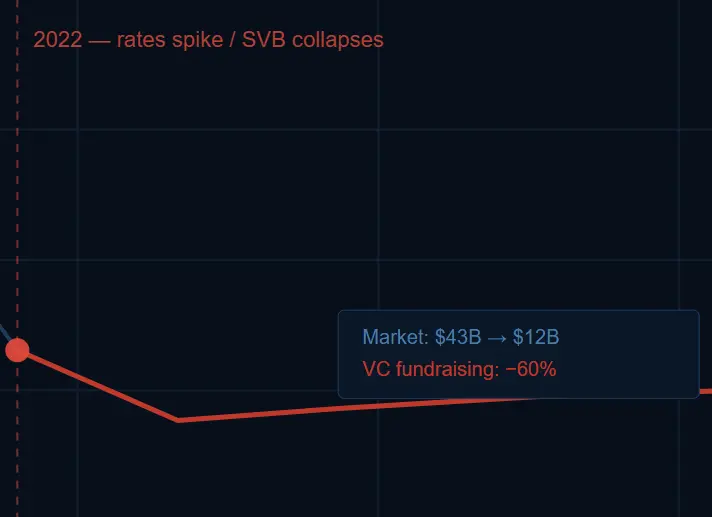
2022 changed everything. Rates rose sharply, IPO markets shut, and venture fundraising fell nearly 60% from its peak — hitting a six-year low by 2023. Then Silicon Valley Bank collapsed in March 2023. SVB wasn’t just a bank. It held roughly 50% of all U.S. venture debt. When it went down in 48 hours, a chunk of the market’s infrastructure went with it. Venture debt outstanding dropped from ~$30 billion to ~$12 billion in under a year.
The position sizing problem nobody talked about
Here’s what made it worse: lenders had been quietly increasing their bets throughout the boom years. By 2020–2021, it wasn’t unusual to see venture debt equal to or exceeding a company’s annual recurring revenue. That’s not underwriting the business — that’s underwriting the venture firm’s reserve capital. The logic was: if this company struggles, the sponsor steps in, protects their equity, and the lender gets paid back. What lenders didn’t account for was a world where sponsors had to triage. When things got hard, VCs didn’t spread reserves evenly. They went all-in on their highest-multiple bets — and quietly stopped supporting the rest. The companies that were “fine but not exceptional” got cut off. Lenders were left holding oversized positions with no equity cushion underneath them.
The VC fundraising collapse hit mid-tier funds hardest
The headline numbers on VC fundraising are bad. The reality for mid-tier managers is much worse. By 2024, the top tier of established VC firms — the names everyone knows — captured ~79% of all venture capital raised. That’s the highest concentration in more than a decade. Meanwhile:
- New fund formations fell 68% from 2021 to 2024
- By H1 2025, emerging managers raised just one-eighth what established managers raised
- The number of sub-$500M funds closing hit multi-year lows
The mid-tier funds that historically backed the broad portfolio of tech companies — the ones that used venture debt most — essentially ran out of follow-on capital. Not reduced. Gone.
The orphaned company problem
The result is a large and growing category of companies that don’t fit anywhere. They have:
- Recurring revenue, often $5M–$50M ARR
- Real customers and genuine retention
- Positive contribution margins
- No path to a traditional venture round
- No sponsor willing to put in more capital
There are more than 50,000 venture-backed companies in the U.S. right now. Most aren’t AI darlings. Most can’t raise a Series B in today’s market. Many are sitting on expiring venture debt facilities with nowhere to refinance. That’s a multi-hundred-billion-dollar pool of companies that need capital and can’t get it through conventional channels.
Why straight debt isn't the answer
The instinct is to replace venture debt with direct lending. It won’t work for most of these companies. Traditional direct lending — fixed amortization, hard covenants, 3–5 year terms — is designed for businesses with predictable, stable cash flows. A $15M ARR SaaS company growing 25% a year but burning $3M annually doesn’t fit that box. The cash flow profile is wrong, and forcing it into a debt structure just creates the next wave of defaults. What the market needs — and what most capital providers aren’t set up to deliver — are structured capital solutions. Instruments that sit between debt and equity, designed around how these businesses actually work:
- Revenue-based financing — repayments tied to monthly revenue, so cash is preserved when growth slows
- Preferred equity — a defined return preference with real downside protection, no fixed repayment clock
- Hybrid instruments — structured notes with equity warrants, convertible facilities, royalty arrangements
- Structured secondaries — buying out VC positions at a discount to provide liquidity and clean up cap tables
These aren’t exotic products. They’re just tools that got ignored when cheap debt was available for everything. Now they’re the right tool for a large part of the market.
The opportunity
The withdrawal of traditional lenders has created real pricing power for disciplined investors who can underwrite these businesses properly — meaning against the company’s own fundamentals, not against a sponsor’s promises. Lower attachment points. Better covenant packages. Equity participation. A borrower base that has limited alternatives and genuine capital needs. This is what a lender’s market actually looks like. Venture debt didn’t break because technology stopped being interesting. It broke because the assumptions baked into the product — unlimited equity backstops, rational position sizing, always-open fundraising markets — stopped being true all at once. For investors willing to do the harder work of underwriting businesses rather than sponsors, and willing to deploy capital through structures that match the actual risk, that dislocation is one of the more compelling setups in private credit right now.
Beyond the Reckoning
The venture debt reset was only the first chapter. The more important story is what followed: capital did not leave the market, it became concentrated. Our next piece examines how that shift is creating one of the most attractive lending environments for specialized structured capital providers in more than a decade.
We provide structured capital for companies in exactly this situation.
If you’re a founder, sponsor, or intermediary working with a company that needs a capital solution outside the conventional frameworks, we’d like to hear from you.